ARTICLES
Can You Actually Put a Stroller in the Overhead Bin?
Sometimes, yes. But “travel stroller” does not automatically mean “carry-on stroller” - and that’s probably the most important thing to understand before buying one specifically for flying.
A lot of compact strollers are marketed with phrases like cabin approved, carry-on compatible, overhead friendly, airline friendly, or IATA compatible. But airlines do not all use the same carry-on dimensions, aircraft do not all have the same overhead bins, and gate agents do not always enforce the rules the same way.

That’s why one parent can fly twenty times with a Bugaboo Butterfly in the overhead bin without a problem, while another parent with the exact same stroller is told to gate-check it. So can you actually bring your stroller into the cabin? The real answer depends on three things: the stroller’s actual folded dimensions, the airline’s published rules, and what happens in real life at the gate.
First: What Do Airlines Officially Allow?
The safest place to start is not with what the stroller manufacturer says. It’s with the airline’s published carry-on dimensions - and, more importantly, whether its stroller policy actually mentions the cabin at all. Here’s what the five carriers we track publish.
| Airline | Published carry-on box |
|---|---|
| American Airlines | 22 x 14 x 9 in |
| United | 22 x 14 x 9 in |
| Delta | 22 x 14 x 9 in |
| Southwest | 24 x 16 x 10 in |
| Air Canada | ~21.7 x 15.7 x 9.1 in (55 x 40 x 23 cm) |
American is particularly explicit about strollers. Its Conditions of Carriage say a fully collapsible stroller under 20 lb may be carried onboard if it fits in an overhead bin, though American also reserves the right to require items to be checked if bins are full or aircraft restrictions apply. United takes a similar position, saying collapsible strollers can be stored in the cabin when space allows.
Delta and Southwest are less generous with the specifics. Delta’s stroller policy confirms free checking at the counter or gate but never actually confirms cabin storage as an option. Southwest publishes a more generous 24 x 16 x 10-inch general carry-on box, but its dedicated stroller policy only describes checking a stroller at the curb, counter or gate - it doesn’t mention the overhead bin at all. A bigger published box doesn’t automatically mean a friendlier stroller policy. Air Canada adds its own twist on top of that: alongside its general carry-on box, it applies a completely separate stroller-specific rule (collapsed diameter under 25.5 cm, length under 92 cm).
On paper, this looks straightforward: measure the stroller, compare dimensions, decide whether it fits. Unfortunately, real life is not quite that clean.
The Big Problem: Many “Cabin Strollers” Are Technically Too Large
Take the Bugaboo Butterfly 2 Plus. Its folded dimensions are around 21.8 x 17.6 x 9.6 inches. Compare that with the 22 x 14 x 9-inch box that American, United and Delta all publish, and the stroller is under the length limit, but wider and slightly deeper than the published allowance.
Technically, it does not fit that box. And yet plenty of parents report carrying Butterfly strollers onto planes successfully. The same thing happens with other popular travel strollers, including the Stokke YOYO³, Joolz Aer², and UPPAbaby Minu V3. This is exactly why the phrase “airline approved stroller” can be misleading - there is no universal approval standard that guarantees a stroller will be accepted in every overhead bin.
Why Do Oversized Strollers Often Get Accepted Anyway?
1. Overhead bins are not airline sizers
A stroller may exceed one published measurement but still physically fit inside the overhead compartment. Published baggage dimensions are standardized rules, while the physical bin may have more usable space in certain directions.
2. Travel strollers look small
Gate agents often recognize compact strollers as travel equipment. A folded YOYO, Aer², Butterfly or Libelle clearly looks different from a full-size stroller, which can affect how strictly it’s treated.
3. Some models are familiar to airline staff
The YOYO is a good example. Some frequent travelers report that airline staff recognize it immediately as a cabin stroller, while less familiar models may be inspected more closely.
4. The aircraft matters
A stroller that fits easily into the overhead bin of a wide-body aircraft may not fit on a small regional jet.
5. How full the flight is matters
Even a compliant stroller can be gate-checked if overhead bins are full. Dimension compliance improves your odds, but it doesn’t create guaranteed bin space.
What Parents Report in the Real World
Real experiences are much messier than the official rules. In recent parent discussions, people report successfully putting models such as the UPPAbaby Minu V3, Bugaboo Butterfly, Joolz Aer², Ergobaby Metro 3, and the Stokke YOYO into overhead bins on major U.S. airlines.
Other parents report the opposite. Some Joolz Aer owners say they were routinely asked to gate-check even after many successful trips. Others say a YOYO was waved through while a less familiar compact stroller was questioned. The contradiction is the point: aircraft, route, boarding group, bin space, gate staff and airport practices can all change the outcome.
So What Does “IATA Compatible” Actually Mean?
You’ll see this phrase everywhere, and it sounds more official than it really is. IATA provides industry guidance, but airlines ultimately publish and enforce their own cabin-baggage policies.
At StrollerSelect, we treat manufacturer claims like “IATA compatible” as useful context, not a guarantee. The more reliable question is: what are the stroller’s exact folded dimensions, and how do they compare with the airline you’re actually flying?
A Few Examples
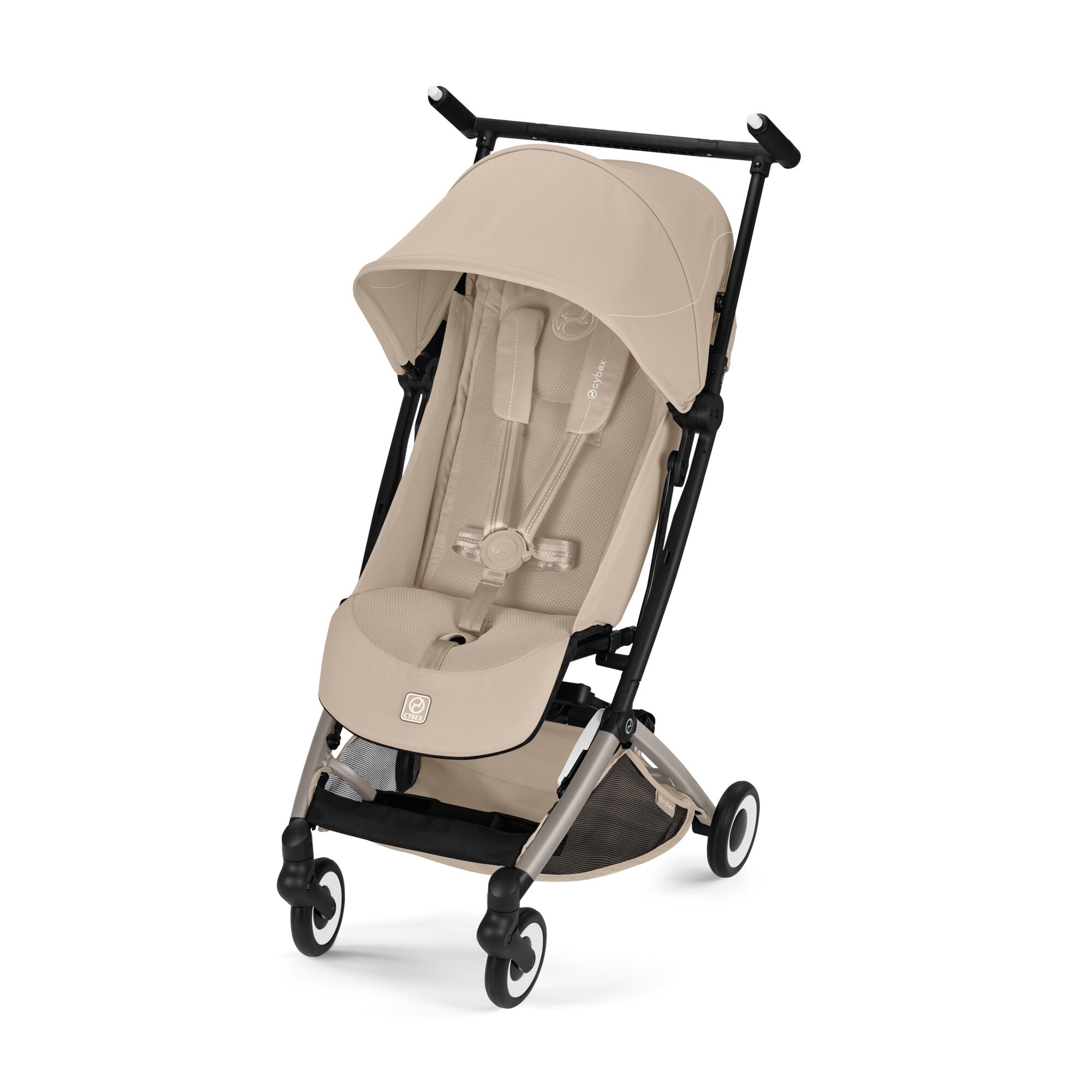
CYBEX Libelle
Folded: about 18.9 x 12.6 x 7.8 inches. This sits comfortably within a typical 22 x 14 x 9-inch U.S. carry-on envelope. It’s the kind of stroller we’re comfortable calling a strong cabin-fit candidate - it works mathematically before we even get into real-world tolerance.
gb Pockit Air All-Terrain
Folded: about 13.8 x 11.8 x 7.1 inches. This folds even smaller. If overhead compatibility is your single highest priority, this type of stroller gives you much more certainty.
Stokke YOYO³
Folded: about 20.5 x 17.3 x 7.1 inches. It fits comfortably in length and depth for a 22 x 14 x 9-inch policy, but its width exceeds 14 inches. Yet the YOYO has one of the strongest real-world reputations for being carried onboard.
Bugaboo Butterfly 2 Plus
Folded: about 21.8 x 17.6 x 9.6 inches. Technically outside a 22 x 14 x 9-inch box, but owners frequently report putting it into overhead bins anyway.
UPPAbaby Minu V3
Folded: about 21.5 x 18 x 10 inches. Again, larger than several major airlines’ published limits, and again, there are real reports of it fitting onboard successfully.
The Three Types of Cabin Fit
1. Fits Published Dimensions
The stroller’s actual folded measurements fall within the airline’s published maximum dimensions. You’re still not guaranteed overhead space, but you have the strongest argument if questioned.
2. Close, but Technically Over
The stroller exceeds one or more limits slightly, while real-world reports suggest similar strollers are often accepted. We think of this as: likely worth trying, but be prepared to gate-check.
3. Clearly Outside the Limits
If the stroller is several inches larger across multiple dimensions, hoping the airline will ignore it becomes much riskier. Plan around gate-checking instead of treating overhead storage as the default.
This is close to how our own Will It Fit tool actually works: we compare your stroller’s exact folded dimensions against each airline’s official box, then apply a small, deliberate real-world margin before calling something a true miss. A stroller within that margin still shows as fitting - alongside that airline’s own cabin-admission caveat - and anything beyond it shows as too big for the standard bag box.
Can the Gate Agent Still Make You Check a Stroller That Fits?
Yes. This is probably the most frustrating part. Even if your stroller is technically compliant, airlines still control cabin baggage based on available space and aircraft limitations. Southwest is the clearest example we track: its own policy page doesn’t even offer cabin storage as an option for strollers, regardless of size.
So there are really two separate questions: does it comply, and will they let me take it onboard today? Those aren’t always the same answer.
What If Your Stroller Is Slightly Too Large?
This is the gray area. Suppose your airline says 22 x 14 x 9 inches and your stroller is 21.8 x 17.6 x 9.6 inches. We wouldn’t assume it will be gate-checked, but we wouldn’t promise it’ll get onboard either.
The useful answer is: many parents successfully carry strollers of this size onboard, but the stroller technically exceeds the airline’s published dimensions, so you should be prepared to gate-check it. That’s the level of nuance we aim to provide - not a misleading green check mark, and not an unrealistic “impossible” label when real-world experience says otherwise.
If Overhead Fit Really Matters, Buy for the Official Dimensions
If you absolutely don’t want your stroller in the cargo hold, be conservative. Choose a stroller that actually fits the published carry-on dimensions of the airlines you fly most often. For carriers using the common 22 x 14 x 9-inch box - American, United and Delta among them - models like the CYBEX Libelle and gb Pockit Air All-Terrain give you much more margin than larger premium compact strollers.
That doesn’t necessarily make them better strollers overall. They may have less suspension, less comfortable seats, smaller baskets, or weaker nap performance. But if your priority is “I really don’t want to gate-check this,” dimension compliance deserves more weight.
A Bigger Box Doesn’t Always Mean a Friendlier Policy
Southwest’s 24 x 16 x 10-inch general carry-on box is the most generous of the five airlines we track - yet its own stroller policy is the strictest one on this list, since it only describes checking a stroller rather than storing it overhead. Air Canada’s general box is close to the smaller American/United/Delta size, but it also layers on a completely separate stroller-specific rule. Neither nuance shows up if you only compare a stroller against a single generic “carry-on size,” which is exactly why a label like “cabin stroller” is less useful than comparing the stroller against a specific airline.
Use StrollerSelect’s “Will It Fit?” Tool
This is the problem we built Will It Fit? to solve. Instead of manually comparing your stroller against half a dozen airline websites, enter your stroller’s folded measurements into the tool. We compare those measurements against every major US and Canadian carrier we track - United, Delta, American, Air Canada and Southwest - and show whether it fits, with that airline’s own cabin-admission caveat attached and the same small real-world margin we build into every comparison on this site, or whether it’s too big for the standard bag box.
Check your stroller with Will It Fit? →
What We Would Do Before Flying
Measure it yourself
Manufacturer measurements are useful, but accessories can change the actual package. Check the stroller with the bumper bar, cup holder, organizer, footrest and travel bag you plan to use.
Screenshot the airline policy
If your stroller genuinely falls within the published dimensions, having the airline’s current policy available on your phone can be useful if there’s confusion.
Fold it before boarding
A stroller rolled up to the aircraft door looks like a stroller that needs gate-checking. A compact stroller already folded inside a travel bag looks more like normal cabin baggage.
Board earlier if possible
The later you board, the more likely overhead bins are already full.
Be mentally prepared to gate-check
Bring a travel bag if damage is a concern, and plan for both outcomes. That makes a gate-check request much less stressful.
So, Can You Actually Put a Stroller in the Overhead Bin?
Yes. Parents do it every day. But these are three different claims: this stroller physically fits in many overhead bins; this stroller meets my airline’s published carry-on dimensions; this airline is guaranteed to let me bring this stroller onboard.
Those statements are not interchangeable. The first may be true even when the second is false, and the third is almost never something we’d promise, because aircraft, bin availability and airline staff still matter.
If you want the highest possible confidence, choose a stroller whose folded dimensions actually fit the airlines you expect to fly. If you already own something slightly larger, it may still be completely reasonable to try, as long as you understand you’re entering the gray zone. Enter your stroller’s folded dimensions in Will It Fit?, and see where it officially fits, where it’s close enough that you may want to try your luck, and where you should probably plan to gate-check. Or skip straight to our six-question finder if you’re shopping for a stroller built around cabin fit from the start.
Frequently Asked Questions
Can I bring a travel stroller as a carry-on?
Sometimes. It depends on the airline’s stroller policy, the stroller’s folded dimensions, available overhead space, and aircraft type.
Do travel strollers count as carry-on baggage?
Policies differ. Some airlines exempt strollers from the normal carry-on allowance while still applying separate rules about whether they may be brought into the cabin.
Will a Bugaboo Butterfly fit in the overhead bin?
It physically fits in many overhead bins, and many owners report carrying it onboard. However, its folded dimensions exceed the standard 22 x 14 x 9-inch box used by American, United and Delta, so acceptance can’t be guaranteed.
Does the Joolz Aer fit in airplane overhead bins?
Many parents report successfully carrying Joolz Aer models onboard, but experiences vary by airline and aircraft. Some users report being asked to gate-check it while others routinely store it overhead.
Which travel strollers are safest if I want official dimension compliance?
Ultra-compact models such as the CYBEX Libelle and gb Pockit Air All-Terrain are particularly strong, since their folded dimensions sit comfortably inside common U.S. carry-on limits.
Can an airline force me to gate-check a stroller even if it fits?
Yes. Airlines may require carry-ons to be checked because of aircraft restrictions or a lack of overhead-bin space - Southwest, for example, only describes checking a stroller in its own policy, regardless of size.